



Blog
Home - Blog
Kitchen Respray or Replacement? What to Check Before You Decide
You might still like where everything sits in your kitchen. The drawers are in the right places, the worktop gives you enough preparation space, and the cupboards hold what you need. It is the yellowing finish or dated cabinet colour that makes the room feel tired.
That is a different problem from a kitchen with damaged units, awkward storage and a layout you have wanted to change for years.
Choosing between a kitchen respray or replacement starts with identifying which problem you actually have. Refinishing can update suitable existing cabinets, but it cannot rearrange the room or restore the strength of a badly damaged unit. Before comparing colours or prices, take a closer look at what is worth keeping.
Does the layout still work?
Think about an ordinary evening in the kitchen. Can you prepare food without constantly moving things out of the way? Do cupboard doors open comfortably? Is the storage useful, or are you always reaching past items you rarely use?
If the arrangement works and the main concern is appearance, a respray deserves consideration. Keeping the cabinets allows you to retain a familiar kitchen while changing its visible finish.
Replacement becomes more relevant when you need different cabinet sizes, a new arrangement or substantial changes to appliance positions. A fresh colour will not create space for a dishwasher or make an inaccessible corner cupboard easier to use.
Write down your frustrations before requesting quotations. Separate appearance issues from practical ones. This makes it easier to judge whether the proposed work will solve enough of them.
Look inside the cupboards, not just at the doors
The fronts usually attract attention first, but the cabinet bodies matter just as much.
Open every cupboard and drawer. Look around the sink unit, inspect exposed edges and check the areas where hinges attach. Photograph anything swollen, loose, split or peeling so it can be assessed.
A small surface chip and a softened cabinet base are different problems. One may be suitable for a local repair; the other needs a closer examination of the affected component and the cause of the damage.
Do not assume a new coating will resolve an underlying leak or make a weakened board sound again. Ask the contractor to distinguish between cosmetic defects, repairable damage and parts that should be replaced.
This inspection may reveal that most of the kitchen is serviceable, with only a few components needing attention. Equally, widespread damage may make a larger replacement project more sensible.
Find out whether the existing finish is suitable
Kitchen doors can have different materials and surface coverings, and these influence the preparation required.
Some laminate cabinets can be painted, but suitability depends on the surface and its condition. Tikkurila’s guidance highlights the need for cleaning and an appropriate adhesion-promoting preparation system on smooth laminate surfaces. That does not mean every damaged or lifting covering should simply be coated over. tikkurila.co.uk
Ask how the contractor will assess your particular doors, especially if the material is uncertain or the kitchen has been painted previously. Close-up photographs of corners, edges and damaged areas are useful starting points.
Spraying describes how a coating is applied. It does not remove the need to identify the surface, address defects and choose a compatible coating system.
Consider the middle option
The choice is not always between spraying everything and removing the entire kitchen.
You may be able to retain sound cabinet bodies while replacing selected doors, damaged panels or worn hardware. Whether that is worthwhile depends on dimensions, compatibility and the appearance you want.
For example, someone who likes the layout but dislikes the door profile may prefer replacement fronts. A respray changes the finish of the existing doors; it does not turn a heavily moulded design into a flat-fronted one.
Discuss any proposed combination before ordering parts. New doors, retained panels and refinished surfaces need a coordinated specification. A colour name alone does not establish that different materials will look identical.
Compare complete quotations
A headline respray price and a kitchen showroom price may cover very different amounts of work.
For refinishing, establish whether the quotation includes door edges, reverse faces, drawer fronts, exposed frames, end panels, plinths and cornices. Clarify repairs, handle changes, removal and refitting, protection and aftercare.
For replacement, ask about removal of the old kitchen, disposal, fitting, worktops, appliances, service alterations and making good. Identify which existing items are being retained.
A useful comparison should show the total cost of achieving the result you want, including VAT where applicable and any clearly stated exclusions.
For instance, Nemo Group UK’s kitchen respray service describes an assessment of cabinet condition and an agreed scope covering suitable surfaces, preparation and finishing. Worktops, appliances, tiling and plumbing are treated separately unless specifically included. That distinction is worth checking in any quotation. Nemo Group UK
Avoid choosing on a promised percentage saving alone. The useful question is what each option delivers for your particular kitchen.
Choose the finish alongside what you are keeping
A cabinet colour needs to work with the whole room.
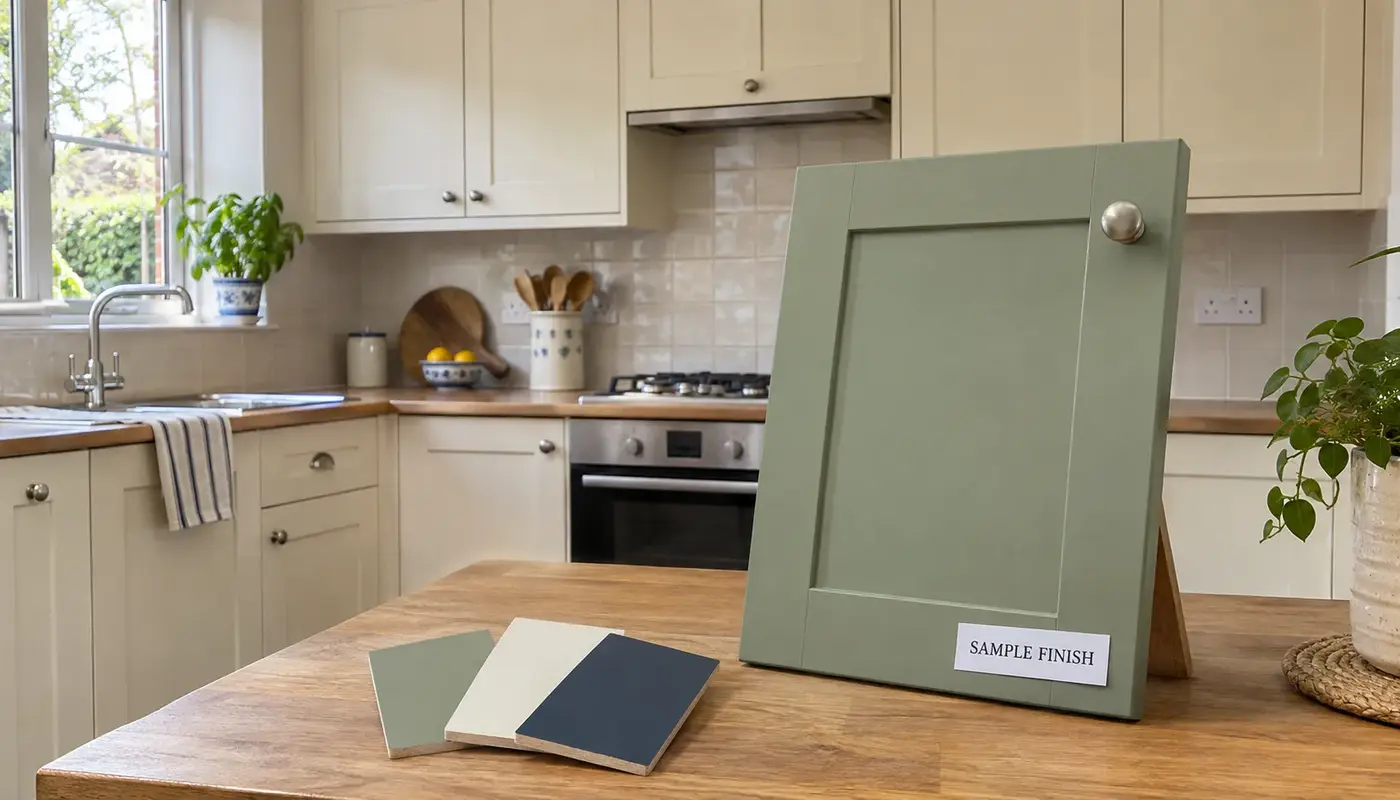
Look at samples beside the worktop, flooring, splashback and appliances. Check them in daylight and under the lighting you normally use in the evening. Include the proposed sheen, because a matt sample and a glossier finish will not have the same appearance.
Think about handles at this stage. Changing their size or position may require existing holes to be addressed before finishing begins.
Ask which visible surfaces will match and which will remain unchanged. Otherwise, newly finished doors can leave an unexpected contrast with retained side panels or exposed cabinet frames.
Plan for disruption and aftercare
A respray still involves preparation, protection and some interruption to kitchen use. Ask which components will be removed, where the work will happen and when access will be restricted.
For either option, request a programme that explains when you can use cooking facilities, storage and work surfaces. Replacement may also involve separate visits for fitting, worktops or service connections, depending on the scope.
For refinished cabinets, distinguish between being dry enough to handle and ready for normal cleaning and everyday wear. Follow the instructions for the selected coating rather than assuming every finish has the same curing requirements.
Before committing, confirm how the finished work will be checked and who to contact if something needs attention.
Make the decision around the kitchen you have
A respray is worth exploring when the layout works, the cabinets remain serviceable and the main change you want is visual. Replacement deserves closer consideration when the kitchen needs substantial repairs, different storage or a new arrangement.
Selective replacement may sit between the two.
Start with a simple record: overall photographs, close-ups of damage and a short list of what does and does not work. Use it to request an assessment and a clear scope. You will then be comparing practical solutions to your kitchen’s problems, with a much better idea of what each quotation will achieve.